
Managing-Anger-and-Chronic-Conditions-

Managing Your Anger

Many of us struggle with anger issues, finding it difficult to be patient and tolerant in the face of extreme provocation, whether it is from a disobedient child, an uncooperative colleague or a rude salesman. If you have a short fuse, you probably find yourself losing your temper frequently, raising your voice and getting aggressive, which only serves to worsen the situation and enhances the stress and negativity in your life.

Anger can also prevent you from thinking creatively, finding solutions and taking effective action. Ultimately, whenever you get angry, the person you harm the most is yourself.

So how can one manage one’s anger and thus become more peaceful? The best place to start is self-awareness – begin to notice when you get angry and why you do so. It could be because of an underlying perfectionist tendency in you, or a desire to have everything your way because of a strong sense that only you know what is right and what is wrong, or unrealistic expectations, or a fixed belief about what others should and shouldn’t do. When you adopt a more tolerant and realistic attitude towards others and stop taking life and yourself so seriously, you may find that you get provoked to anger less often. Often, an angry reaction is just a bad habit, and despite self awareness and an understanding of where it is coming from, it will require time and patience to develop a new way of expressing yourself to replace it.

The important thing is not to repress anger but to accept and acknowledge it with compassion, and then release it gently. Resisting it will only make it persist, and being hard on yourself or labelling yourself harshly for getting angry will only make it strengthen as your go-to emotion. Understanding the pattern in your anger and whether it’s coming from a deeper place or from a past experience which was not fully expressed, will help you release it. Ultimately, like other emotions, it needs to be fully acknowledged and embraced as part of the whole human being that you are, rather than repressed, resisted or condemned.


distorted-thinking-counseling-Charlotte-720x380

Distorted Thinking

We know our thoughts control our actions and our behaviour, and therefore they control and create our lives. But how many of us are really in control of our thoughts, adept at keeping at bay the runaway train that is our mind, which before we know it, has sped off into an anxiety attack or is deeply immersed in fear and worry, and worst-case scenario thinking?

It is so easy for us to twist the reality around and become victims of what psychologists call distorted thinking, where we may imagine things which are not there, and get worked up and anxious about situations which are just not real.

What exactly is distorted thinking? Psychologists have identified several different kinds of distorted thinking which include the following:

  • All or none thinking – You look at things in absolute terms; you are either perfect or no good, there is nothing in the middle. Perfectionist thinking falls in this category.
  • Overgeneralisation – You see a negative event in terms of a recurring pattern, so if you have lost one tennis match, you will always lose in tennis.
  • Mental filter – You focus on the negative and don’t see the positive in any given situation.
  • Discounting the positive – You believe that the positive doesn’t count.
  • Jumping to conclusions – You simply presume that things are bad without any valid reason or factual proof.
  • Mind-reading – You presume that other people are thinking negative thoughts about you.
  • Fortune-telling – You see a negative outcome in the future.
  • Magnification or minimisation – You either exaggerate the importance of something out of proportion to what it is or reduce its importance. A common distortion with people who are prone to “What if” thinking.
  • Emotional reasoning – You believe that if you feel it, it must be true, therefore “I feel stupid so I must be stupid”.
  • Should statements – You live your life by a list of shoulds and shouldn’ts. If you don’t do what you think you should, you feel guilty and if others don’t do what you think they should do, you feel angry and frustrated.
  • Labelling – You give yourself a global label such as “failure” or “loser” or simply “a bad person” instead of saying “I failed at that task”.
  • Blame – Either you blame yourself and take personal responsibility for someone else’s problem, or you blame someone else for your own predicament.

It is only when we first realise and acknowledge that our thinking is distorted, and then make a conscious effort to base our thoughts on facts and reality, that we can transform our lives for the better.

mountains-g80a7b3f00_1920

Scarcity vs Abundance Mentality

Though we live in an abundant world, many of us are deeply immersed in a scarcity mentality, believing the pie is small and therefore there is not enough to go around. This belief affects every aspect of our lives, whether it is with regard to wealth, opportunities, status, talents, gifts, or success and achievements of any kind. People with a scarcity mentality believe there can be only one winner, only one person in the number one spot, to be good you have to be the best, and if someone else wins, they lose.

These people, with a low sense of self worth, are constantly comparing themselves with others and their self worth comes from doing better than others, from beating others who they look upon as their rivals, their opponents. They also find it difficult to share success with others, and are unable to be happy for anyone else’s achievements.

People with an abundance mentality, on the other hand, have a strong sense of self worth and security, and they believe there is plenty out there for everyone. They believe that there can be multiple winners, multiple people in the spotlight, that many people can share in the prestige, profits and the abundance that the world has to offer; and no one has to lose for them to win.

Stephen R. Covey writes in his highly acclaimed book ‘The Seven Habits of Highly Effective People’: “People with a Scarcity Mentality have a very difficult time sharing recognition and credit, power or profit – even with those who help in the production. They also have a very hard time being genuinely happy for the successes of other people – even and sometimes especially members of their own family or close friends and associates. It’s almost as if something is being taken from them when someone else receives special recognition or windfall gain, or has remarkable success or achievement.”

sunflower-fields-g891f5e56a_1920

Living in the Present Moment

Whether it is spiritual teachers or motivational speakers, we are constantly being urged to live in the present moment, to tear our minds away from the past and the future into being in the now, if we want to be happy and have peace of mind. So significant is present moment thinking that Eckhart Tolle, a spiritual teacher and best-selling author, has devoted an entire book, ‘The Power of Now’, to this subject. In his New York Times bestselling book, Tolle says “The more you are able to honour and accept the Now, the more you are free of pain, of suffering and of the egoic mind.” He explains that “What you think of as the past is a memory trace…the future is imagined…past and present have no reality of their own.”

If you notice your own thinking, you will realise that your mind is constantly fluctuating between what happened last week or last month or even a few years ago, or then it moves into thinking of what is to come, whether it is next week or next month or five years from now, with “what if” thoughts. And invariably what this sort of thinking does to us is to make us anxious, fearful and worried, because it reminds us of something unpleasant from the past, or then brings forth an imaginary scenario from the future which is more often than not negative and pessimistic.

The question we need to ask ourselves is how does this past and future thinking serve us? Does it make us feel happy and peaceful? Is it based on fact and reality? Is it necessary to think in this way? If you are honest with yourselves, you will answer “No” to all these questions. If it doesn’t benefit us in any way, then why exactly do we do it? The reality is that past or future thinking is completely unnecessary and full of pain and suffering and we can quite easily live without it. This sort of thinking is coming from our egoic mind and has just become a bad habit.

The happiest and most peaceful way to live is to focus on what is happening around you at this very moment. Give your full attention to what you are reading or writing, look deeply at the trees and the flowers when you are walking outside, and if you are watching television, give your full attention to the show that is on. This is what being in the present moment is all about, being fully absorbed in your task, giving your full attention to what is happening here and now, rather than letting your mind slip into the past which is over, or fast forward into the future which hasn’t happened yet, so any thoughts related to it would simply be your imagination at work.

Meditation is an excellent tool to train the mind to focus on the present. By focusing on your breath or a mantra, you can bring your mind back to centre where you will find peace. Eckhart Tolle suggests that you focus on your inner body to bring your attention back from fearful thoughts of the past and the future. He says: “Become aware of your breathing, feel the air flowing in and out of your body, feel your inner energy field….the key is to be in a state of permanent connectedness with your inner body, to feel it at all times. This will rapidly deepen and transform your life.”

jared-rice-NTyBbu66_SI-unsplash

Breaking the Spiral of Negativity

If you are like most people, you will find that your thoughts usually veer to the negative as if pessimism was the default setting of the mind. Isn’t it so easy for the mind to switch from a positive happy state to one of anxiety, worry and fear? And then like an unwanted guest who just won’t go away, the negative thoughts stay stuck in your head, going round and round in circles until you make a conscious effort to get rid of them.

The average person is said to have about 60,000-70,000 thoughts per day, and over 90 per cent of these thoughts are the same, repeated day after day.

So what can we do to break this spiral of negativity? The answer is to train the mind to think positively; so just like you would adopt a new way of doing something to replace an old habit, similarly you have to replace negative thinking with positive thoughts. And when it comes to learning anything new, even a new way of thinking, you have to start with small steps and build up gradually over time.

The starting point is self awareness. You need to be aware of your thoughts before you can change them. For this, you have to tune in to what you are thinking, to catch yourself thinking anxious, fearful thoughts. Keeping a journal and writing down the thoughts you want to change is a useful exercise which helps you clarify your thinking. The next step would be to replace the negative thought with a positive one, and then you need to firmly repeat it to yourself over and over again until you start believing it.

It’s undoubtedly a long and tedious process but if you stick with it, you will notice your pessimistic perspective being replaced by a new sense of optimism. And eventually you will feel greater happiness and peace of mind. As A. Parthasarathy says in the ‘The Eternities: Vedanta Treatise’: “Thinking is skilled work, you need to learn and practice it.”

Spiritual leader Shri Shri Ravi Shankar, the founder of the Art of Living Foundation, says:

Watch your thoughts, they become words
Watch your words, they become actions
Watch your actions, they become habits
Watch your habits, they become character
Watch your character, for it becomes your destiny

So do take the time and make the effort to change your negative thoughts; this single action will change your life!

4516859

Mirror, Mirror on the Wall…!

It’s so easy to be critical and judgmental not only of others but of ourselves too. Instead of being our own best friends, many of us are our own worst critics, constantly berating ourselves for saying or doing the wrong thing, performing below par, or not being as successful as our next door neighbour.

When you look at yourselves in the mirror, do you see a perfect, dearly loved face or a flawed one? Do you see your loving eyes and warm smile or your misshapen nose and uneven skin tone? Unfortunately, for most of us, the mirror reveals only our blemishes and flaws, the features that we are convinced make us look unsightly to the rest of the world. In fact we are so used to seeing only our negative qualities that we simply can’t see the good in ourselves even though others can. And even if we do see that flawless skin or thick eyelashes, our minds are unable to hold on to the pleasant thought for long, and inevitably we descend into the spiral of negative thinking once again.

When our thinking is set to negative mode, it is important to make a conscious effort to focus on the positive in ourselves, even if it is only for a few minutes every day. The best time to do this is in the morning before you set out for the day. Louise Hay, best-selling author and motivational speaker, advocates looking at yourself in the mirror every morning and telling yourself “I love you” repeatedly to reaffirm your love for yourself. Once you begin to feel positive feelings flow through you at the sight of yourself in the mirror, make an effort to notice all those qualities that you like in yourself, aspects of your face and body that make you feel good and bring forth a smile. Then during the rest of the day, whenever you catch a glimpse of yourself in the mirror, remind yourself of these positive qualities and of how much you love yourself.

Self-love is the foundation of a healthy self-esteem and feelings of self-worth. When you love yourself, you give more love to others and you also attract more love from others into your life. So begin a love affair with yourself today by looking at yourself in the mirror and telling yourself just how much you mean to yourself.

positive-thinking-g8f717f824_640

Always Be True to Yourself

To be happy and achieve your personal and professional goals, you need to love yourself and accept who you are with all your strengths and weaknesses. You need to accept yourself the way you did when you were a child, before your ego developed and you began comparing and competing with other people, convinced that being yourself wasn’t good enough.

Why isn’t being you good enough? Who else can you be if you aren’t yourself? And can you be anyone else even if you wanted to?

Since you obviously can’t be anyone else but yourself, why not be happy with who you are and live your life to the fullest? Why not celebrate your uniqueness, make the most of all those remarkable qualities that have come together to make you who you are, and strive to be the best version of yourself? When you accept yourself the way you are, the good as well as the not-so-good, you are:

  • Liberated from the opinions and actions of others
  • Not fearful of being judged or rejected
  • With self-love and self-acceptance, you don’t look to others to decide how you should live your life, but turn inwards and listen to your inner voice. You pursue your own dreams and desires rather than the dreams and desires of others, and you achieve your own unique purpose.

    Instead of comparing and competing with others, you compare and compete with your own self. You learn from your mistakes and try to get better and better so that you can maximize your potential and reach the summit of your own life.

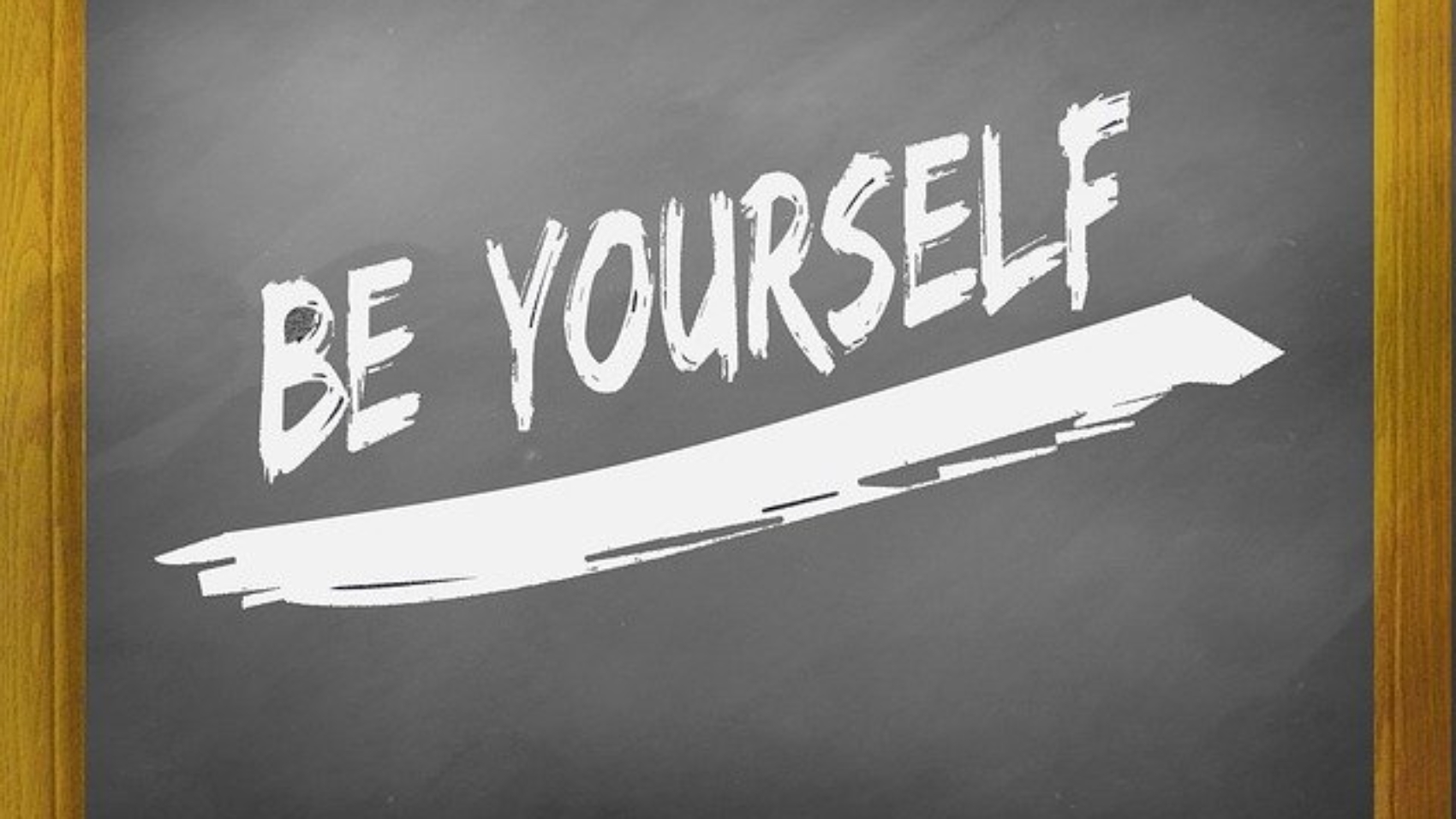
    So why not be yourself? As Oscar Wilde said so wisely: “Be yourself, everyone else is already taken.”

    closeup-two-young-lovers-holding-hands-table (2)

    Be yourself and live your life to the fullest!

    To be happy and achieve your personal and professional goals, you need to love yourself and accept who you are with all your strengths and weaknesses. You need to accept yourself unquestioningly the way you did when you were a child, before your ego developed and you began comparing and competing with other people, convinced that being yourself wasn’t good enough.

    Why isn’t being you good enough? Who else can you be if you aren’t yourself? And can you be anyone else even if you wanted to?

    Since you obviously can’t be anyone else but yourself, why not be happy with who you are and live your life to the fullest? Why not celebrate your uniqueness, make the most of all those remarkable qualities that have come together to make you who you are, and strive to be the best version of yourself?When you accept yourself the way you are, the good as well as the not-so-good, you are:

    • Comfortable in your own skin and feel worthy rather than less than or more than others.
    • Liberated from the opinions and actions of others.
    • Not fearful of being judged or rejected

    With self-love and self-acceptance, you don’t look to others to decide how you should live your life, but turn inwards and listen to your inner voice. You pursue your own dreams and desires rather than the dreams and desires of others, and you achieve your own unique purpose.

    Instead of comparing and competing with others, you compare and compete with your own self. You learn from your mistakes and try to get better and better so that you can maximize your potential and reach the summit of your own life.

    So why not be yourself? As Oscar Wilde said so wisely: “Be yourself, everyone else is already taken.”